
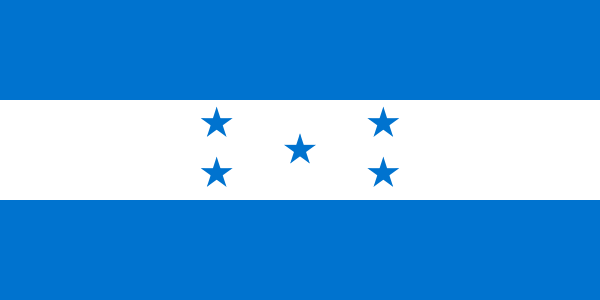
About Honduras
In the heart of Central America, mountainous Honduras is a land of vibrant culture, ancient Maya history, and resilient people. From the lush Copán ruins to the Garifuna villages of the Bay Islands, the nation balances its rich heritage with modern challenges. Despite enduring history-shaping events like Hurricane Mitch, the spirit of Honduras shines through its welcoming people. In the northern coastal plains, the scent of fresh plantains and the sounds of punta music fill the air, a testament to Garifuna culture. Further inland, the bustling streets of Tegucigalpa, the capital, tell stories of resilience.
Once a centerpiece of the Mayan civilization (250AD–900AD) and later shaped by Spanish colonization, Honduras gained independence in 1821. It is known for its biodiversity, including the scarlet macaw. In recent times, the country has navigated political shifts and social change, yet it remains a place where family and community hold paramount importance.
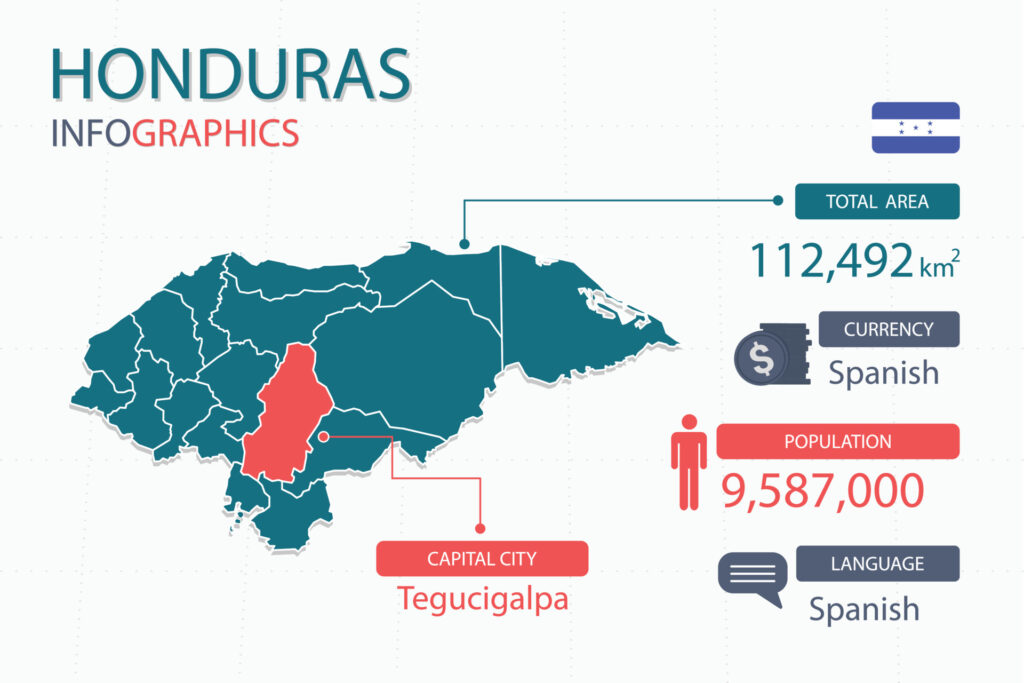
Honduras is bordered by three countries and two bodies of water. It is bounded to the west by Guatemala, to the southwest by El Salvador, and to the southeast by Nicaragua. The country features a northern coastline on the Caribbean Sea and a southern outlet to the Pacific Ocean. Honduras covers approximately 43,433 square miles (112,490 km²), making it roughly the size of Ohio (106% of its area) or slightly larger than Virginia. It is about 87 times smaller than the United States.
Honduras is distinct in Central America as the only country without volcanoes, boasting a unique, mountainous, and heavily forested terrain. It features, for the most part, an unexplored, dense, and biodiverse interior, alongside the ancient, artistic Maya ruins of Copán. Furthermore, its culture is deeply influenced by a diverse population, including the Garifuna and Lenca, rather than solely Spanish-mestizo, and it stands out for its unique, flour-tortilla-based cuisine.
The climate varies from tropical in the lowlands to temperate in the mountains. The central and southern regions are relatively hotter and less humid than the northern coast.
The Need in Honduras
Healthcare in Honduras faces significant challenges, characterized by a fragile and fragmented public system with limited resources. Although care is free in the public sector (SESAL), its coverage is inefficient, and it faces shortages of medicines and personnel, with a quality of care considered low. The Instituto Hondureño de Seguridad Social (IHSS) covers roughly 37.1% of the working population. It is often underfunded, with limited access in rural areas. There is a high prevalence of chronic diseases, such as obesity (63.8% in 2022) and diabetes (9.3%). Nearly 9 out of 10 people lack health insurance coverage, and approximately 18% to 20% of the population does not have access to healthcare services. Public hospitals frequently face recurring crises, including shortages of essential medicines, inadequate staffing, and deteriorating infrastructure.
“God loves you when you give to others. He heats you up inside. If you live His life in you, you will see His life in others. You have to recognize God’s presence even in someone’s misery. If you love God, you will see his image in others, especially the poor” – Sister Maria Rosa – founder of SAN
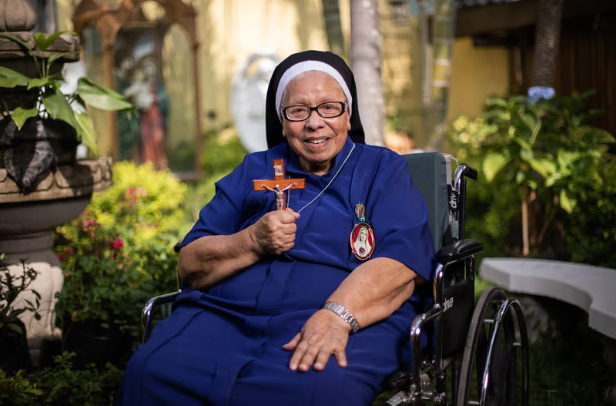
Sister María Rosa began organizing medical brigades with the support of international volunteers due to Hurricane Mitch, a category 5 storm that devastated Honduras between October 26th and November 1st, 1998, causing the worst natural disaster in the country’s recent history. The torrential rains caused massive flooding and landslides, leaving more than 9,000 dead, thousands missing, and nearly the total destruction of infrastructure and agriculture, affecting more than 2.5 million people.
After 28 years, access to healthcare in Honduras faces significant structural challenges, with nearly 18% of the population lacking access, and the vast majority without health insurance. The system is divided into public (SESAL/IHSS) and private sectors, with geographic, economic, and infrastructure barriers limiting coverage and affecting comprehensive care.
Where We Serve in Honduras
Based primarily within the Honduran capital city of Tegucigalpa, Sociedad Amigos de los Niños (SAN) strives to help Honduras’ most vulnerable. For more than 50 years, SAN is a non-profit organization governed by a board of directors. SAN works along three main pillars; homes, education, and health. Sociedad founder Sister Maria Rosa Leggol has delivered hope and an opportunity to forge a brighter future by fostering confidence and skill-development in the children and families she works with. Sister María Rosa, whom many called the Mother Teresa of Central America, was an icon in Honduras and was known for her admirable work both nationally and internationally. She promoted a large number of impactful humanitarian projects that continue to serve children, youth, families, and communities today, with the aim of improving their quality of life and laying the foundation for a more just society—one capable of confronting any difficulty, fighting for its rights, and primarily serving as an example of faith, with strong values and principles. Her work was, is, and will be everlasting.
Cultural Exploration
With ISL Honduras, you’ll have many opportunities to explore the culture of those you serve through a variety of activities. Our Sociedad Amigos de los Niños (SAN) Camp operates within a closed circuit/secured facility. We maintain this strict environment primarily for the safety and security of the vulnerable beneficiaries we serve. Because of this, students at this specific camp will not have direct, open contact with the surrounding local communities. However, we want our volunteers to have a rich experience, and to do so we have designed some fantastic, intentional cultural activities that fit safely within our structure. Honduran Cooking Lessons give students an opportunity to participate in a hands-on cooking class where students will learn how to prepare traditional Honduran dishes (like baleadas or pupusas). The Cultural Exchange at Hogares Nuevo Paraíso is our orphanage facility, where we can arrange interactive activities, games, and storytelling sessions, allowing for a meaningful, heartwarming cultural exchange between the students and the children. These activities will provide the intentional “cultural highlights” you are looking for while respecting our safety protocol
Recreation
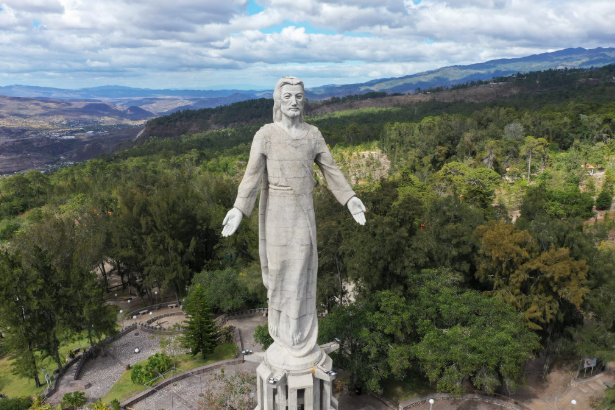
Honduras offers diverse recreational activities, from world-class scuba diving and snorkeling in the Bay Islands (Roatán, Utila) to exploring Mayan ruins at Copán Ruinas. Visitors can hike in national parks like La Tigra or Pico Bonito, go rafting on the Cangrejal River, visit wildlife sanctuaries, and enjoy beaches. Near the camp, we have Valle de Ángeles, a charming colonial town famous for being the “cradle of artisans” in Honduras. Known for its cool mountain climate and preserved 16th-century appearance, it is the most popular weekend getaway for residents of the capital. Another local site is La Tigra National Park, a cloud forest that offers extensive biodiversity and well-marked trails, while El Picacho (or United Nations Park – El Picacho) is a prominent, high-altitude park and tourist landmark in Tegucigalpa, Honduras, known for its iconic 20-meter Christ statue (Cristo del Picacho) overlooking the city. Situated at 1,300+ meters, it offers panoramic views, walking trails, and botanical gardens.
Recreational opportunities may have an extra cost so check with your ISL Representative when scheduling your activities to make sure that you prepare well for those expenses.
Country Coordinators
International Service Learning (ISL) is very proud of their Country Coordinators and we would like for you to get to know them, before you visit their beautiful country. All of our Country Coordinators are hardworking, passionate individuals who enjoy serving their communities and working with ISL volunteers, and they all have their own very unique stories.
Marina and Luis are both from Tegucigalpa, capital City in the State of Francisco Morazan. In early childhood both were greatly impacted by Sister Maria Rosa and the SAN program. Through the resources of the program Marina decided to study at the university to become a teacher, while Luis studied journalism in college. Both have excelled in their fields of study. Together, Marina and Luis look for relationships in the community with governmental or private organizations to do service learning. They have established governmental relationships with the Ministry of Health, the general hospital, and with an organization that helps restructure families in need. Also, they are involved with the community centers in the city, both governmental and private, with churches, and with rehabilitation centers. The country coordinators work together with these organizations in every way possible to bring service to the community and to give the volunteers the opportunity to have more practical training, to get to know the health system, and to understand the culture.
Honduras's Staff
We love our staff and we are positive that you will too! Each staff member is professional, courteous, and has the same passion as you do: to serve others.